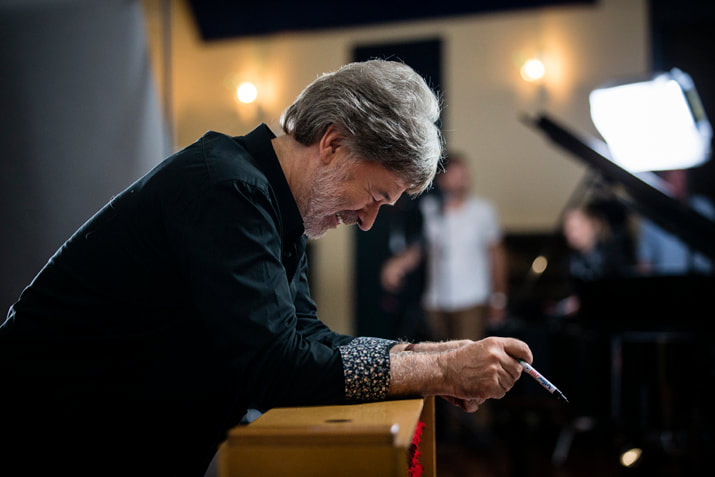
In 2001, Brian Matthews started contributing monthly columns to Eureka Street.
He remained an occasional contributor until recently.
Most of us, when pushed, can name a couple of teachers who had a profound influence on our lives. For me, Brian Matthews was one such teacher.
I enrolled in English at Flinders University in 1972. On asking the enrolling officer whether anybody was “doing anything about Lawson”, I was directed to the office of Brian Matthews, a recent appointment to the English Department.
“I hear you know something about Lawson,” I said, leaning in his doorway.
He turned in his chair and looked up at me. “Oh, maybe a bit.”
This was an understatement of some magnitude. Matthews was then putting the finishing touches to “The Receding Wave”, a controversial analysis of Lawson’s artistic and physical decline which got him into a fair bit of trouble with the Lawson cheer squad. In the decades that followed, Matthews became a leading international authority on the life and the works of Henry Lawson.
As Brian later wrote, I “saddled up” for English. He turned out to be an extraordinary teacher and, in subsequent years, I enrolled in every course he taught. Among many other things, Brian Matthews and the other profound influence on my life, Brian Medlin, taught me that wit, wisdom and erudition did not have to be delivered in a faux Oxfordian accent, so beloved of many academics at the time.
A great friendship developed beyond the classroom walls. In subsequent years, until his recent and sudden decline, we wandered across the literary terrain together, told each other stories, jousted, laughed - and drank just a little.
Brian Matthews, an Australian academic and author, was born in St Kilda shortly after Christmas in 1936. He was educated at De La Salle College and Melbourne University where he did a BA in the 1950s and, later, an MA under the direction of Vincent Buckley.
After graduating, he taught in rural Victorian schools before travelling extensively overseas. Returning by ship from London, he met his first wife, Jeanne, on board. They married in Melbourne in January 1963 and had five children before adopting a Vietnamese refugee in 1973. In the late 1980s, Jeanne and he separated though they remained friends. In 1993, he married Jane Arms, a literary editor.
Matthew’s first academic posting was at the Bedford Park Teachers College in Adelaide in 1967. Shortly thereafter he joined the English Department at the newly established Flinders University where he proposed a course on Australian literature - only the second in the nation. It went on to attract students from all over Australia who were keen to immerse themselves in their own culture.
In 1974, Matthews took his young family to Exeter where he taught Australian literature for the year. This was the first of many international academic postings.
As a Fulbright Scholar in Residence at the University of Oregon in 1986, Brian Matthews made Australian literature and, to a lesser extent, Australian history the central concern of his lectures, collaborations and advisory roles.
In 1990 Brian Matthews became Chair of the Literature Board of the Australia Council. In 1993, Matthews was appointed as Head of the Menzies Centre for Australian Studies at the University of London. He used this professorial appointment to advance the cause of Australian literature in the UK by, among other things, convening a series of readings by visiting Australian authors.
Subsequently, Matthews accepted visiting professorial roles at the universities of Venice, Trento and Lecce where he deployed what he described as his “passable Italian”. Returning to Australia at the end of 1996, he became Foundation Director of the Europe-Australia Institute at Victoria University, Melbourne, a position he held until 2003.
A passionate devotee of the Australian vernacular, wit and ironic nuance, Brian’s literary output was a successful blend of populism, intellectualism and egalitarianism.
Louisa, Matthews’ highly successful biography of Louisa Lawson (Henry’s mother) was published in 1987. The book won several awards and attracted international recognition for its revolutionary re-imagining of the biographical method. After the success of Louisa, Brian Matthews was commissioned to write the biography of Manning Clark which eventually appeared in 2008.
Brian Matthews’ history of the MCG, The Temple Down the Road, is regarded as a superb contribution to Australian history and popular culture. His later work, Benaud: An Appreciation, was, in the words of the late John Clarke, “…a brilliant meditation on a unique sportsman – on character and gifts and time”.
Brian Matthews’ autobiography, A Fine and Private Place, is now a central reference for the study of working class life in St Kilda in the 1940s.
Between 1997 and 2001 he contributed a weekly column to The Australian Weekend Magazine. These pieces developed a cult status and were published as a highly successful collection called As The Story Goes.
In 2001, Matthews started contributing monthly columns to Eureka Street. He remained an occasional contributor until recently.
Never truly comfortable in cities, Brian retired with his second wife in the Clare Valley in this South Australia and then coastal Victoria. He returned to spend the last years of his life on a small property in the Adelaide Hills, the area where he had raised his family.
It was here he and I would sit in the dull afternoon light, drinking beer, yarning broadly and telling the same stories to each other. Nonetheless, every moment with Brian was an informal, vastly amusing tutorial.
Brian Matthews was an important and influential figure on the Australian literary landscape. He was also an outstanding teacher. A number of his students went on to make their own significant contributions to our national culture. We all acknowledge his inspirational role in our careers.
Brian Matthews died in Strathalbyn on June 2nd, 2022. His impact on our country is not to be underestimated.
I shall miss him.
John Schumann