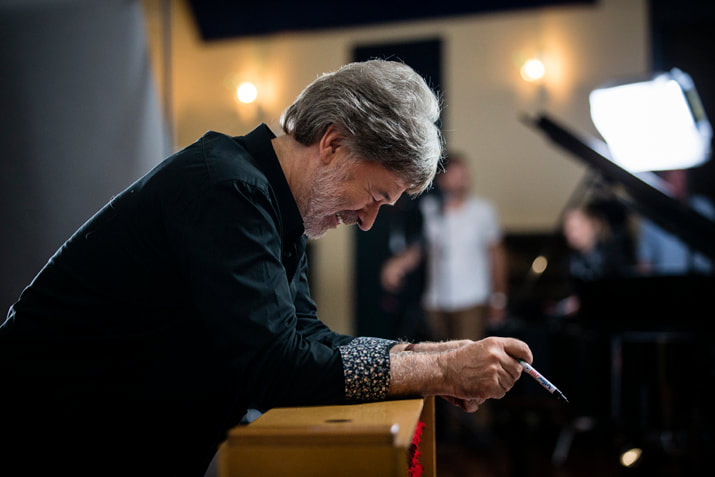
John Schumann, lead singer-songwriter of the Australian folk-rock band, Redgum, and the creator of “I’ve Been to Bali Too” first went to Bali in 1976. He formed a lifelong friendship with Tjokorda Krishna Suharsana and was adopted by Krishna’s family – “brothers from a different mother” according to Krishna’s mother, Henni.
This story, written shortly after the Kuta bombing in 2002, reflects on friendship, family, culture, the old Bali and the two-edged sword of tourism.
It is particularly resonant in these days of Covid 19.
Bali. After the bomb.
I’d flown into Denpasar on the Qantas midnight shuttle from Darwin on any number
of occasions but I’d never seen the Darwin terminal so empty. Even after all the news
stories and the emails from Krishna and Cathy in Bali, I was surprised at how quiet it
was. I reckon only one in three seats on the flight over was occupied – which was good because the flight was delayed and then delayed - and then delayed some more. At least I got to spread out and doze fitfully as the 737 droned and bumped its way across the Arafura Sea.
In fairness it was 3.00am when we landed at but the Nuragh Rai International Airport was like a catacomb. Even the normally grumpy airport officials made a perfunctory
attempt at welcoming us. “So,” I thought to myself as I headed for the door,
“when did Immigrasi start smiling at tourists?”
Selamat datang ke Bali.
Outside the terminal my Balinese brother, Tjokorda Krishna Sudharsana, waited for
me, leaning up against his new Kijang, smoking a kretek. Hugs, tears and we climbed
into the car for the 45 minute trip to the Sudharsana Puri – Krishna’s family home
which comprises the eastern wing of the palace at Ubud.
It was July 2003 and I’d flown up within a couple of days of hearing about the
death of Krishna’s Dad, Tjokorda Oka Sudharsana. Krishna and I go back a long way.
We’ve been close mates – more like brothers- since we met back in 1976
Oka and I loved each other and I was devastated to hear of his passing.
On the way up I observed to Krishna that things seemed very quiet. Over the years I’d
travelled these roads at all times of the day and night and I’d never seen it like this.
“Ah, Brother,” he said, “things are very bad in Bali after the bomb. You’ll see
tomorrow when it’s light.” And in the morning, see I did.
I’ve knocked around Bali for a long time and in 40 years I’ve seen Ubud grow from
an artists’ village without sewerage, electricity and running water to become a smogged,
clogged tourist stop, replete with Post Office, footpaths and cement kerbing , a Starbucks and at least five ATMs.
But Krishna was right. This was something else. Ubud footpaths, usually spilling over
with tourists from all over the world, were clear and free-running, apart from the
Balinese themselves. Drivers, normally hustling work on these footpaths, abandoned
their vehicles outside the market and hung around in small groups inside, smoking
kreteks and drinking tea. The few tourist buses I saw were close to empty, as were the
restaurants, as were the shops and the cafes.
“They’re selling postcards of the hanging”. Desolation Row everywhere I looked.
We left shortly after lunch and drove up to Klub Kokos. Krishna and his Australian
wife, Cathy, have built a delightful artists’ retreat, Klub Kokos, in the hills about 30
minute’s walk from the Ubud market. Other than a 45 minute walk, you an only get there by slowly and carefully picking your way between pits and pot-holes in a vehicle with a fair bit of ground clearance. It’s worth the effort. Klub Kokos gets you
as close to the old Bali as I’ve been in 40 years.
Krishna is a Tjokorda from the palace in Ubud so he and Cathy have serious social
and economic obligations to the people in their village of Bangkiang Sidem.
Klub Kokos provides jobs for the villagers, a market for their rice, fruit and
vegetables as well as funds for the school, the roads and the electricity supply.
Krishna and Cathy know as well as anyone what Bali after the bomb is like.
“Bookings are down, well down on previous years, but people are starting to come
back,” Krishna told me. “We’re lucky because people who know us and stay at Klub
Kokos know that here is as safe as anywhere in the world. It’s the other Balinese, the
more mainstream tourism people that are suffering more.”
“People stopped coming to Bali for a while after the bomb, especially Australians.
Tourists are slowly coming back but for many Balinese it’s going to be too late.”
Knowing that many families in Bangkiang Sidem rely, directly or indirectly, on Klub
Kokos for their livelihoods, I asked Cathy how she and Krishna were able to keep on
being the economic heartbeat of Bangkiang Sidem, especially after the bomb.
She smiled and shrugged. “We just have to keep doing it. We can’t stop and think
about it. There’s no other option for the villagers or for Krishna as a Tjokorda. It’s his
responsibility as a prince from the palace.”
The daily practice of Balinese Hinduism demands that people go to considerable effort
and expense to make sure that the forces of good and evil remain in balance.
That this unspeakable episode happened on the Island of the Gods devastated the
Balinese. The repercussions of the Kuta bombing on Balinese society can scarcely be
imagined –in spiritual, cultural and economic terms.
My brother Krishna is a painter with an international reputation. I don’t know much
about art but over the years I have watched Krishna develop his own unique,
identifiable style- using strong, warm, primary colours and swirling circles. However,
his work since the bomb was all black and red, stark whites and dirty greys. There are
straight, hard lines, angles, dark shadows and faces in burning windows. We spent
a couple of hours in his gallery one day and I listened to him talk about why he painted these works.
“People in Bali blame themselves for the bomb,” Krishna explained. “We believe
that we must have done something very wrong for this to happen. People in Bali now
look at what we have been doing in our lives to cause this.”
He was speaking of himself as well. Krishna is well-educated, well-travelled, highly
intelligent and talented. He is also a deeply religious man who, like other Balinese,
blames himself for the actions of a few mad men.
“I think I can paint other things again now,” he said quietly, “but I had to paint this
out of my soul.”
As Krishna and I moved between Ubud, Bangkiang Sidem, Denpasar and Gianyar,
doing family stuff, organizing things after his father’s passing, I saw many, many
buildings seemingly halted in mid-construction.
Krishna explained again: “Many Balinese people borrowed from the banks to build
accommodation, galleries, cafés and shops. We believed tourism would grow forever.
Now, after the bomb, these people have been living on what they have and that is
running out. They cannot afford to continue and they cannot afford to go back. Can
you imagine what will happen to these places?” He gestured out the window of the
Kijang.
“The banks are in trouble because they have no way of getting their money back. So
bank people are selling these places cheap to foreigners and Javanese because their
bosses in Java now tell them to get back the money from the bad loans. Many people
in Bali who have land will have to sell it to stay alive and feed their families. Slowly,
slowly we will lose our island.”
We are in our sixties now, Krishna and I. When we met we were in our early twenties, full of laughter, music and Bintang beer. I used to stay at the Menara with the Mas family and Krishna and I spent many hours with his uncle, Tjokorda Agung Mas, who was, until his passing, the world’s leading authority on gamelan music.
Tjok Agung had established the small Mudraswara Foundation at the Menara to record the music and the dances of Bali. As far back as 1976, Tjok Agung was worried that the influx of tourists and western influences would distract young Balinese from learning them. Balinese music and dances were not written down: rather, they were taught, handed down from father to son, mother to daughter, uncle to nephew. Tjok Agung was
frightened of a “missing generation”. Ironically, in 2003, it seems that tourism has
provided an impetus to keep the music and the dances alive. But today there is
another, perhaps more critical, missing generation.
“Many young people now have no jobs in Kuta, in Legian, in Nusa Dua and Sanur,” said Krishna,
“They’ve come back home to their villages but they don’t know how to grow rice or vegetables. They never learned because when they left school, they left
their villages too and went to work - driving, cleaning, sweeping and cooking in
hotels. They have motor-bikes now but they have no knowledge of growing food like
their parents did.”
“And now the gods are showing us that we cannot always rely on tourism and we should look again at the old ways of Balinese life. But we have lost a generation.”
“The old men know how to grow rice. They read the sky for rain. They can
cut the channels to irrigate the paddies. It’s a science, Brother. They know when to plant. The young people don’t know these things and maybe the old people will die before they can teach the young ones. Before tourism, in Bali everyone could eat well.”
Each year we commemorate the unspeakable events of October 12th and mourn our
own losses. I think of the Balinese. Many of us have had life-changing
experiences in Bali and many of us have had love and hospitality lavished on us by
Balinese friends and families. I’ve been fed, sheltered, looked after, nursed and
welcomed into a family with great love and affection. My own family knows that the
one thing we can do to repay this love is to go back.
It won’t be politicians who will lead us to victory in the war against terrorism. It will be ordinary Australian families and ordinary Balinese families reaching out to each other across the sea. If we don’t do this, the terrorists will win. And whatever happens, they must not win.
PS January 2021
John and Krishna are still in very regular contact. Covid 19 continues to devastate the Balinese and the tourism industry. No one knows when - or even if - this will end. It’s as if what happened to the Balinese after the Kuta bombing was just a dress rehearsal for the Covid 19 pandemic.